Previous Reports from Kevin
Hello again from Antarctica,
Ok, well, I'm back at McMurdo Station. All went very well in the field
- our instruments worked great, we collected lots of data, and had an
amazing time exploring a phenomenally interesting and unique little
nook on planet Earth. Now for the background on what exactly we're
doing.
I sent off my last email right before we were heading
off via helicopter to our field site. The destination is called
Battleship Promontory - it's a beautiful band of sandstone towers
nestled within the trans-Antarctic mountains and as you'll see in the
pics, the name suits the structures.

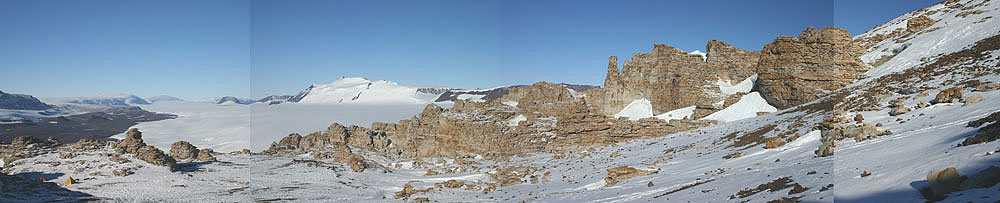
Pic 1. Battleship Promontory, Dry Valleys,
Antarctica. Our camp can be seen (just barely) in the left-hand corner.
[click to enlarge]
We were headed there to study the microbes that live within the rocks.
Originally, no one thought life could exist in such a harsh, dry, cold
environment, but back in the '70's Dr. Imre Friedmann, now at UW
Seattle, inherited a rock sample from Antarctica that later led to him
giving birth to the field of studying cryptoendolithic microbial
communities (cryptoendolith - meaning within the pore spaces of rocks).
Friedmann discovered complex communities of lichens (fungi + algae) and
cyanobacteria thriving within the sandstone rocks of the Dry Valleys.
Much remains to be understood about how these communities live, die and
ultimately modify the geological setting around them. On our team were
two of Friedmann’s prodigies - Dr. Henry Sun of the Desert Research
Inst. and Dr. Chris McKay, of NASA Ames. Their role was to help guide
the rest of us through their well-trained eyes. As for the rest of us
(8 people total), we had all been working on specially designed
instruments that would help us study these life forms in the field. The
idea was to bring the instruments to rocks, instead of bringing the
rocks to the lab.

Pic 2: Me with our mid-infrared spectrometer. An
instrument well suited for studying the mineralogy and organic
chemistry of the rocks in this region.
Studying microbes is tricky in that regard, if you change the
environment they often change what they're doing. Thus, studying life
in the lab often tells you one thing while in reality the little
buggers may be doing something quite different in their home environs.
My role was primarily as an engineer working with Bob Carlson of NASA
JPL on a set of three spectrometers (fancy prisms that split light and
yield info about chemical composition) designed to study the mineralogy
and organic chemistry of the rocks. Along with furthering our
understanding of what makes these life forms tick, NASA is also
interested in seeing how our field instruments perform. The ultimate
application would be for future robotic landers, a case where all of
your instruments are sent off to a far and distant field with no one
standing by to press the reset button if something goes wrong. At least
two of our instruments had been proposed for the 2009 Mars Rover.
Neither was selected, but we'll likely try again during the next round.
So that's the background, now for some stories and pics.

Pic 3: Helicopter taking off with part of our team and part of our several ton science load.
Flying machines will never cease to amaze me. They
simultaneously seem to defy physics while at the same time serving as
one of the most dramatic examples of physics beautifully at work. We
boarded our helicopters, loaded with a few tons of gear, and headed
across McMurdo Sound en route to Battleship Promontory.

Pic 4: An iceberg trapped in the sea ice of
McMurdo Sound. My guess is that the wall of this iceberg is somewhere
in the range of 100 feet high.

Pic 5: The Trans-Antarctic Mountains, as seen from our helicopter.
After navigating through the labyrinth of mountains we came upon our
destination and the helo pilots set us down. I personally, was
incredibly excited, as were the others in my helicopter. But when we
got out and had a chance to look around, I noticed a concerned look on
Chris' face. He and Pan and Henry had flown out in the first helicopter
to scout out the location. When asked what the issue was, he pointed
down the hill. We needed to be there. About 350 feet down a snowy talus
field.

Pic 6: The view from "Upstairs". All of our gear
was dropped off on this plateau...but we needed to establish camp down
below, in the sandstone rocks. The traffic of hauling our gear up and
down inspired the name "Broadway", given to the snow and rock gulley on
the left, down which we hauled much of our gear. Our initial tent sites
can be seen just past the shadow in the center of the picture.
The pilots had complications landing within the sandstone structures
and so they dropped us up high on a flat plateau. That was all well and
good - we could easily hike down and establish camp within the
sandstone. The problem was our gear, in particular getting all of our
heavy science gear down the hill. We spent the rest of the day
shuttling essentials (tents, food, etc.) down to the desired campsite.
As a result of all this traffic, our route up and down the mountain
would later be named Broadway.
It took a few days, but eventually the helicopters were
able to help us get our science gear down to the camp and before long
we were up and running.

Pic 7: Help is on the Way. A helo lifts off with
some of our gear as we pile on top of the rest of the gear to make sure
it doesn't get blown away.

Pic 8: Rho smiling after a close encounter with the helicopter. See pic 7 for 'close'.
Conditions were beautiful and our science proceeded well. The pictures
will give you a sense of this stunning landscape and some of the
close-ups of the rocks will give you a sense of what we're studying.
First, just look at the pictures of the cliffs and you see that the sandstone rocks are 'painted' with various colors.

Pic 9: Our camp at Battleship Promontory. After much hard work, we finally had a place we could call home.

Pic 10: View across the valley showing the cliff
buttress that forms the base of the Battleship Promontory sandstone
formation. The cliff is roughly 600 feet high.

Pic 11: A close up of one of the lichen-colonized
sandstone rocks. The dimension of the picture is roughly 3 feet by 2
feet. Which colors are indicative of life beneath the surface? This is
one of the many questions we sought to answer.
Upon closer inspection - see lifeColorPatches.jpg - you'll see that the
surface of some of these rocks are covered by a mosaic of browns,
yellows, oranges, and reds. These colors result from both inorganic
(non-biological) and biological chemical reactions. The bugs (microbes)
within the rocks play a role in how the rocks look and how they
weather. Someone like Henry, who has a trained eye, can look at the
colors and discern where the microbes live beneath the surface. Part of
our technical challenge was to see if our instruments could accomplish
the same task. In this particular picture, you can see some black spots
around the edges of some of the rock flakes. This is the lichen poking
out from under the rock. It has probably become exposed because a chip
recently fell off the rock as a result of wind erosion.

Pic 12: A cross section view of one of the rocks
we analyzed. Our mid-infrared spectrometer can be seen at top. The
coloration of the interior of the rock results from an interaction of
the lichen community (thin black line near the top of the rock) with
iron that is deposited at the surface and transported to the interior
(bright red line).

Pic 13: Through a hand-lens (magnification 15x)
one can see the dark spots of microbes inhabiting the regions between
the clear sandstone crystals.
Henry, Bob, and I worked together on our mid-infrared, near-infrared,
and visible spectrometers. We had the system set up so we could be
running 24 hours a day, collecting as much data a possible. We set up a
rotating sleep schedule so that someone was always awake to check on
the instruments and to make adjustments when needed. We had a bit of
troubleshooting here and there, but overall things worked as planned.
Bob and I had spent two days testing out our system in a walk-in
freezer at JPL and that was proving to be time well spent.

Pic 14: Me, Henry, and Bob (L-R) during one of
our 'late-night' hikes around the fascinating formations of Battleship
Promontory.

Pic 15: Bob and Henry enjoying a warm drink in our 'BP Cafe' after working hard to get the instruments up and running.
Our biggest limitation was power - we had solar panels
but we were expecting more of them from the supply shop at McMurdo. The
team had a small generator and that worked well until the oil dried up.
Then we had to resort to really optimizing for every possible photon we
could collect from the sun. Henry, Bob, and I grabbed the extra solar
panels used to recharged to the communications equipment and added them
to our array. We lashed together some bamboo poles and set up shop on
top of a small hill near the campsite. When we were done, our newly
christened 'solar city' on top of Sun Hill looked like something
straight out of Gilligan's Island.

Pic 16: Solar City on top of Sun Hill, named both
for the star that powered our instruments and the talented biologist,
Henry Sun, who was on our team and who has done so much work in the
area.
Recall that since we're at ~77 degrees south, at this time of year the
sun never sets. Thus, as the sun made its circle around the sky we
would periodically go up to the hill and rotate our array. For a few
hours each day the sun was eclipsed by the big mountain behind our
camp, but other than that we had plenty of sunlight on clear days.
The rest of the team seemed to keep pretty standard
hours, while Bob, Henry, and I got into this fun cycle of trading
shifts during the day and then around 3 or 4 in the morning the three
of us would set the instrument on autopilot and head off for a hike to
explore some yet to be explored region of the mountainside. This lead
to many great discussions, discoveries, and views (e.g. see
meadowscliff.jpg). Hiking around the sandstone formations gave one the
sense of hiking around some ancient ruins with meandering corridors and
teetering towers. The silence and serenity is stunning. The cold air
clears the mind. The timeless landscape is incredibly humbling, but
invigorating.
More in a few days...

Pic 17: Me with the sandstone formations in the background and Mt. Morrison in the far background.